
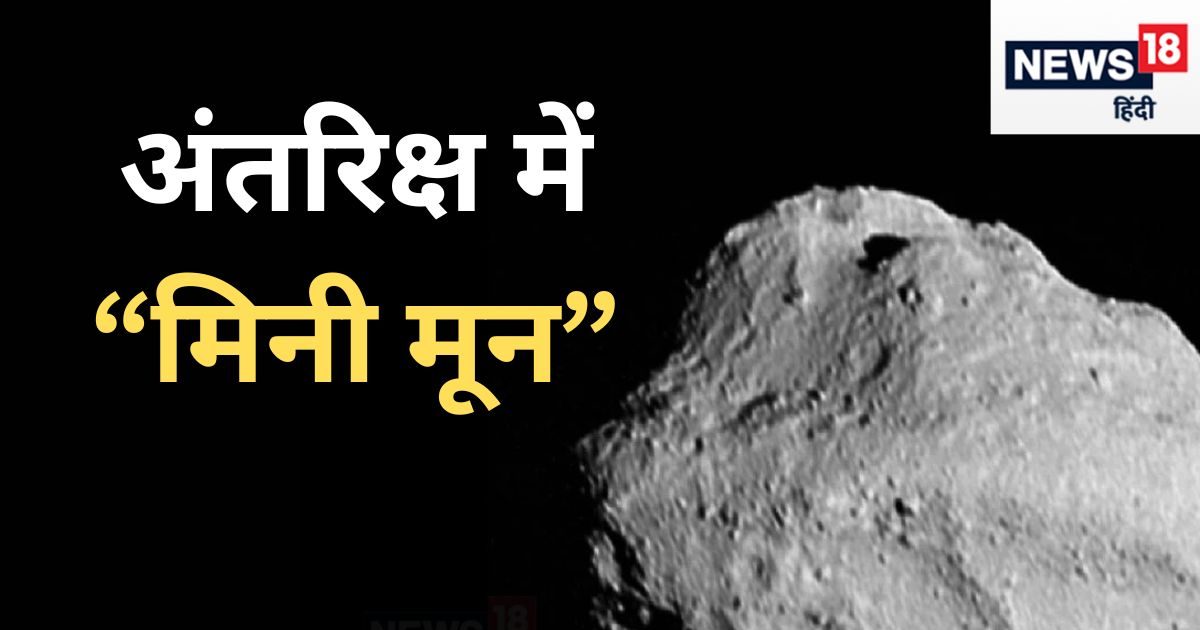
Washington. America’s space agency NASA has got another big success. NASA’s spacecraft Lucy has made a major discovery in space. A mini-moon, a small fragment of the moon, has been discovered by Lucy, which has been observed orbiting the asteroid Dinkinesh. According to scientists, this discovery means that asteroid Dinkinesh has its own moon. NASA has also taken pictures of it. Spacecraft has confirmed that Dinkinesh is not alone. One-tenth the size of the moon revolves around it.
Scientists have captured an image of asteroid Dinkinesh and its “mini moon” about 434 km away by spacecraft. Dinkinesh and its new moon reside in the main asteroid belt between the orbits of Mars and Jupiter, about 300 million miles (480 million km) from Earth.
This is why we explore. Turns out Asteroid Dinkinesh is… Asteroid Dinkinesh? Meanwhile #lucimissionThe first asteroid flyby on Nov. 1, we discovered that the main belt asteroid is a party of two, or a binary pair! https://t.co/3aYWLvWmOw pic.twitter.com/IX2ZHHtRdK
— NASA Solar System (@NASASolarSystem) November 2, 2023
“Dinkinesh really lives up to its name, which means ‘you are wonderful’ in the Ethiopian Amharic language. This NASA mission is also making amazing discoveries,” said Han Levinson, who supervised the Lucy spacecraft. That this mission is to find the mysterious asteroids, for which the spacecraft Lucy is working. Lucy was sent close to Jupiter, the largest planet in the solar system. It was launched in 2021, and will remain in space until 2027. The main goal of the mission is to find 8 asteroids known as Trojans. A group is to be studied.
Recently, scientists from the University of Arizona said that Kamoolewa, considered an asteroid orbiting the Earth, is also part of the Moon. Scientists have been researching this for many years. The presence of silicates on it makes it a possible source of the Moon. According to the research scientists, it is very close to our planet and it orbits the Earth every year in April.
,
Tags: the moon, lunar orbit, NASA, A NASA study
First published: November 4, 2023, 13:46 IST