
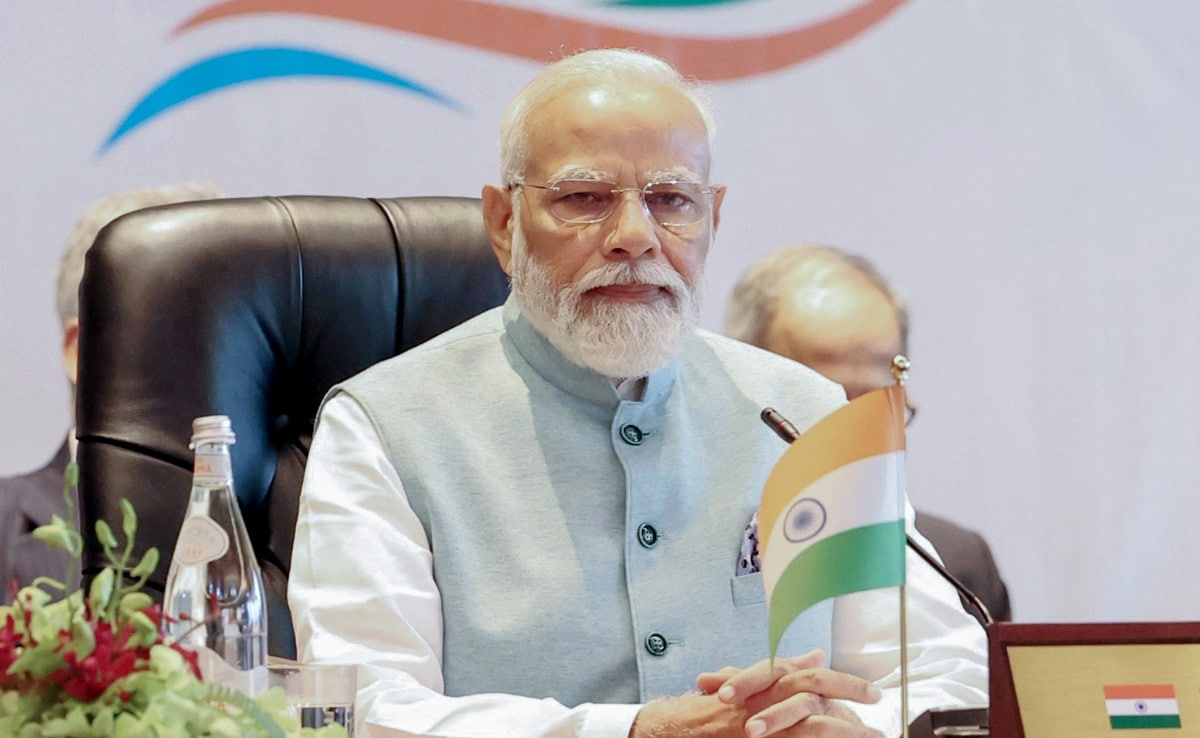
In an interview to ‘India Today’ magazine, the Prime Minister said that ‘Modi’s guarantee’ is not a formula designed to win elections, but it is the faith of the poor. The Prime Minister said that today every poor person of the country knows that Modi will not back down from his duty. This trust of the poor gives me energy too…I will not let this trust break.
PM Modi also said that to make India developed by 2047, the focus will be on ‘knowledge’ i.e. G for poor, Y for youth, A for breadwinner, N for women empowerment. While discussing, Modi drew parallels between the period 1922-1947 and the next 25 years.
‘…this energy is my driving force’
He said, “In the period from 1922 to 1947, everyone wanted to contribute to the freedom movement. I see the same optimism among people that by the time we celebrate 100 years of independence, India will be a developed country.” done This energy is my driving force.”
The Prime Minister said, “If we pay attention to ‘knowledge’, respect ‘knowledge’ then India will develop. ‘Gyan’ means ‘G’ means poor, ‘Y’ means youth, ‘A’ means giving, ‘N’ means Mahila Shakti.” When asked about the BJP’s selection of new faces as Chief Ministers of the three major states of Rajasthan, Chhattisgarh and Chhattisgarh. Madhya Pradesh. Modi said that this seems to be a new trend, but it is not new for the party.
The Prime Minister said that in fact he is the best example of this tradition within the BJP. Modi said that when he became the Chief Minister of Gujarat, he had no previous administrative experience and was not even elected to the Legislative Assembly. “Most other parties today are dynastic parties and they find this democratic churn difficult,” he said.
‘There is no corner of the country where our party does not have support’
PM Modi said that the BJP is a cadre-based party, driven by a clear mission and capable of taking on many generations of leadership at once. Asked about the BJP not ruling any major southern and eastern states, the Prime Minister pointed to the party’s growing support base in the country and said, “There is no corner of the country where our party does not have support.”
“Despite being the main opposition party in many states, from local bodies in Kerala, our party is doing strong work among the people,” he said. Modi also underlined that the BJP is in power in 16 states and in eight. The main cons are. party
The prime minister said the BJP is in government in six northeastern states, including predominantly Christian-majority Nagaland and Meghalaya. He also said that “as far as South India is concerned, we are the largest party in terms of Lok Sabha seats.”
Expressing confidence about the upcoming general elections, Prime Minister Modi said there is a consensus among people, experts, opinion makers and friends of the media that “our country does not need a coalition government.”
‘The Politics of Appeasement, Corruption in the Age of Coalition Government’
PM Modi said, “We lost 30 years due to the instability caused by the coalition government. People have seen lack of governance, appeasement politics and corruption in the era of mixed government. Due to this, people’s optimism and self-confidence went down and India’s image in the world went bad. So naturally people’s choice is BJP.
The Prime Minister’s comments are significant ahead of the Lok Sabha elections, where the opposition ‘Bharat’ alliance is poised to challenge the BJP.
On the Supreme Court’s recent decision on abrogation of Article 370, he said that Article 370 has ended forever and the people of Jammu and Kashmir and Ladakh are free to shape their destiny for the first time.
Discussing the development approach of Jammu and Kashmir and Ladakh, he said, “The government has focused on security, development, investment in infrastructure and human capital and reshaping government processes through reforms. We have adopted a multi-dimensional approach,” he said. , ‘ ‘We are on track to ensure lasting peace, stability and prosperity by improving the living standards of the people of the region, promoting economic development and creating employment opportunities.’
Highlighting his principle of ‘Nation First’, Modi said, “Whatever I have done, as an activist, as Chief Minister and as Prime Minister, I have always put the nation first. Whatever decision I have taken is in the national interest. have taken
People often ask him how he takes difficult decisions, Modi said, “I don’t find it difficult because I take all my decisions from a nation-first perspective.” “I don’t do anything to feel good, I do it. To be good,” he said of the mantra behind his approach.
‘Draw a line in stone if you must…’
On his approach to choosing difficult and uncomfortable subjects like cleanliness and hygiene, Modi said, “Makhan pe lakhir toh sab karte hai. If you have to, draw it in stone. Even if it’s difficult, so what, just start.” , the Prime Minister also said that the hidden potential of the nation has come out and now India’s presence and contribution is being appreciated on the global platform.
He said the world opinion today is clear – “This is India’s moment.” Discussing the economic reforms in the country, Modi said that (economic) reforms should be brought to improve the standard of living. He said that India’s development journey has progressed at a faster pace as a result of such reforms. Modi also expressed confidence that India will become a five trillion US dollar economy.
On criticism of inflation and lack of adequate jobs, the Prime Minister said India has performed remarkably despite disruptions in value chains due to the two-year-old pandemic of a century and global conflicts and economic slowdown across the world.
He said the average inflation during 2014-15 to 2023-24 (till November) was only 5.1 per cent, compared to 8.2 per cent during the previous 10 years (2004-05 to 2013-14). Modi said that job creation is the highest priority of my government. All our efforts have been made to achieve this goal.
Discussing the rapid pace of infrastructure development in the country, the Prime Minister said that infrastructure is being built at an unprecedented pace and all sectors are performing much better than 10 years ago.
On promoting semiconductor chip manufacturing and other important and emerging technologies in the country, the Prime Minister said the semiconductor mission was something that should have started 30 years ago. “We’re already late,” he said.
Elaborating on the efforts being made in this regard, he said, ‘We have taken a big leap in our semiconductor manufacturing mission. Our focus is now on bringing the entire ecosystem of electronics manufacturing to India covering the entire value chain.
Modi also spoke about efforts to develop India’s leadership in Artificial Intelligence (AI). “We will leverage the diversity of Indian languages and our computing power in a large indigenous language model keeping in mind our needs,” he said.
Regarding India’s chairmanship of the G20, Modi said, “We were able to focus on human-centred development on the global agenda. We inspired the developed and developing world to build consensus. We revived multilateralism.
Referring to the inclusion of the African Union as a permanent member of the G20 during the summit in New Delhi, the Prime Minister said that India’s presidency would be a platform to position the ‘Global South’ in shaping the global discourse. .
‘Don’t let terrorists or violence set the agenda’
Clarifying India’s position on global issues such as the Ukraine crisis and the war in Gaza, Modi said, “I have always believed that honest dialogue and diplomacy should be the preferred path to resolve differences in an environment free from fear and pressure.” Whether in Ukraine or Gaza, our approach is guided by this belief.”
Also Read:-
Why did Nitish take charge of JDU, a bigger identity than Lalan or an easy deal with Bharat Gatbandhan?
Govt signs peace accord with ULFA, Home Minister Amit Shah says – ‘Big day for Assam’