
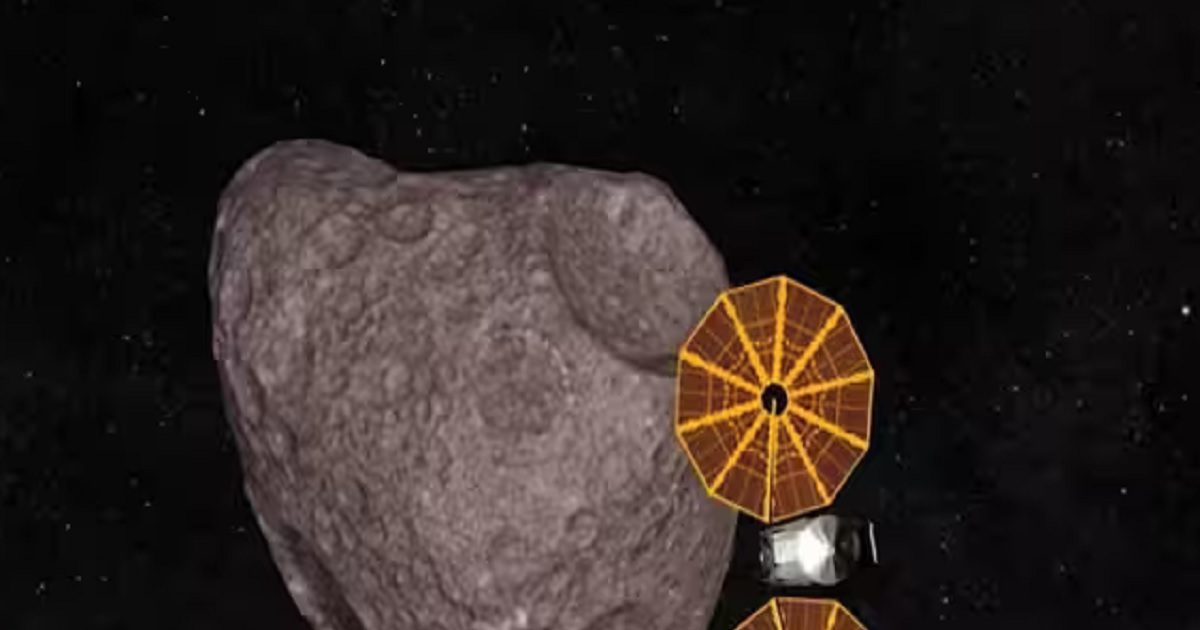
Washington. NASA’s Lucy mission has discovered a remarkable binary asteroid system in the first photo downlinked. Scientists have photographed asteroid Dinkinesh and its ‘mini moon’ about 434 km from the spacecraft. Dinkinesh and its new moon reside in the main asteroid belt between the orbits of Mars and Jupiter, about 300 million miles (480 million km) from Earth.
Initially, it was noted that the two lobes of the binary were adjacent to each other. But studies of other photos have revealed the true nature of the system. Earlier images sent by the spacecraft showed that Dinkinesh, or Dinky, has a satellite with its own moon around it. Now some shocking information has come out about this moon. The satellite orbiting Dinkinesh is not one but two interlaced space rocks, meaning two smaller objects in contact with each other.
Why are the two components of the satellite the same size? Such an arrangement was not expected
This means that the entire system is not made up of one or two rocks, but actually three space rocks. ‘This is surprising to say the least,’ Hal Lewison, Lucy’s principal investigator, said in a statement. I never expected a system to look like this. In particular, I don’t understand why the two components of the satellite are the same size. It will be interesting for the scientific community to find out. While contact binaries are not uncommon in the Solar System, seeing them up close is rare. What makes this discovery special is that one asteroid orbits another.
A reflection on the strange variations in the luminosity of dinkinesh
Dinkinesh observed distinctive brightness variations indicating the presence of a satellite. “Contact binaries appear to be quite common in the Solar System,” said Lucie Deputy Project Scientist John Spencer of the Southwest Research Institute in San Antonio, Colorado. We haven’t seen many asteroids up close, and we’ve never seen one orbiting another. We were thinking about the strange changes in the brightness of Dinkinesh that we saw as we approached, which suggested to us that Dinkinesh might have some kind of moon, but we never suspected anything so strange!’
The purpose of the Lucy mission is to explore Jupiter’s Trojan asteroid
Lucy’s primary objective is to find Jupiter’s Trojan asteroids, including an encounter with a small, main-belt asteroid like Dinkinesh in early 2023. It serves as a testbed for the spacecraft’s tracking and imaging systems during high-speed flybys. “Dinkinesh really lives up to its name, which means “you are wonderful” in the Ethiopian Amharic language,” said Han Levinson, who supervised the spacecraft Lucy.
The Lucy mission was launched in 2021
This NASA mission is also making amazing discoveries. Let us tell you that this mission is to find mysterious asteroids, for which the spacecraft Lucy is working. Lucy was sent close to Jupiter, the largest planet in the solar system. It was launched in 2021 and will remain in space until 2027. The main goal of the mission is to study a group of 8 asteroids known as Trojans.
,
Tags: asteroid, the moon, NASA, A NASA study
First published: November 9, 2023, 05:01 IST